Why Does the Scale Mess With My Head So Much?
For most people we work with, the scale doesn’t necessarily feel like a relationship.
It’s just… there. Part of life. Part of the bathroom. Part of the required routine.
And yet, for some people, if they really evaluated it, it’s an extremely abusive relationship.
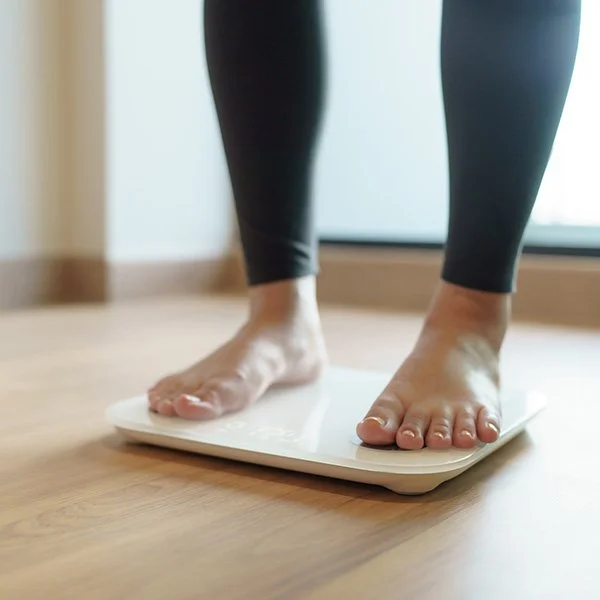
Clients tell us the scale quietly decides things like:
whether they’re “allowed” to eat that day
whether they did “okay” or royally fucked up
whether they deserve kindness… or punishment
Some people avoid the scale completely, not because they’re confidently following their dietitian’s advice, but because they’re terrified of what it will say and how devastating it will feel.
Some check it multiple times a day, because the constant changes feel urgent and all-important.
Some don’t even realize how much power it has until it ruins their mood for the entire week…and it’s not even 6 a.m.
If that’s you, this isn’t a character flaw. It’s a system that’s been given far too much authority.
What the Scale Is Actually Measuring (And What It Isn’t)
Let’s slow this down for a moment.
The scale measures the amount of mass in your body × the earth’s gravity in that exact moment.
That number includes:
water (a huge variable)
food still digesting
muscle
fat
bones
organs
inflammation
hormones doing hormone things
Weight naturally shifts throughout the day and from day to day.
For menstruating people or people with ovaries, monthly hormonal changes alone can significantly impact water retention, and therefore the number on the scale, without reflecting health, nourishment, or “progress” of any kind.
Each scale is also calibrated slightly differently. For most people, that doesn’t matter much. But for someone with an unhealthy relationship with food or body image, even a small change can feel enormous; emotionally, mentally, physically.
Not because the change means something. But because the number has been taught to carry meaning.
Why the Scale Feels So Emotionally Powerful
The number on the scale often feels powerful because it’s concrete.
And in some cases, it’s been backed by so-called “official” definitions from the medical community (ahem- the ridiculous BMI charts) that suggest some numbers are better, safer, or more acceptable than others.
When someone feels uncertain, unsafe, or disconnected from their body, a number can feel like proof:
proof that things are getting better (either in an eating disorder or in recovery)
proof that they’re “doing it right” (again, either one)
And on harder days, it can become:
Proof that something is wrong
Permission, or a reason, to restrict
Fuel for self-criticism, in the hope that being harder on yourself will finally make things change
The scale becomes a stand-in for self-trust. And that’s a lot to ask of a bathroom object.
Why We Often Encourage Stepping Away From the Scale
For many people with disordered eating or a fraught relationship with the scale, we often encourage not using one, at least for a period of time.
Not because the scale is inherently bad.
Not because you’re bad for wanting to check.
And definitely not as a punishment.
But because when a number starts determining:
whether or what you eat
whether or how long you need to exercise
how you feel about yourself
your self-worth
how safe or anxious you feel in your body
…it stops being neutral information.
It starts interfering with healing.
For some bodies and brains, removing the scale creates space.
Space to notice hunger and fullness.
Space to assess energy, mood, focus, and sleep.
Space to rebuild trust internally instead of outsourcing it to a number.
And if the idea of not weighing yourself feels terrifying, that’s not a failure, that’s information. We meet that with curiosity, not force.
What Neutral Information Actually Looks Like
Think about taking your temperature.
If it’s 97.5, 98.6, or 99.0, you probably don’t think much of it.
But if one day it’s 97.5 and the next it’s suddenly 104.3, what do you do?
If prior to taking your temperature you felt achy, feverish, and miserable, the number makes sense. But if you felt totally fine, no chills, no fatigue, no other symptoms, most people’s first thought is, Is the thermometer broken?
They don’t assume their body is broken.
Now imagine if a jump of 7lbs happened on the scale.
For many people with an unhealthy relationship with weight, the immediate conclusion isn’t something’s off with the scale.
It’s: “I did something wrong.
My body is broken.
I shouldn’t have eaten what I ate yesterday.”
With a thermometer, we don’t make moral judgments about the number.
We don’t let it decide whether we deserve care.
We use it as one piece of information, filtered through how the body actually feels.
The scale could be just another biometric marker like that.
But for many people, it’s been turned into something much bigger, something that skips curiosity and goes straight to judgment.
Imagining Something Different
Living with your days dictated by a number is exhausting. And it makes sense in a culture that taught us bodies must be constantly monitored to be acceptable.
What might it be like to decide what and how much to eat based on hunger, satisfaction, and what sounds good to you?
What might it be like to decide what kind of day you’re aiming for—how supported, nourished, or steady you want to feel, rather than letting a number decide for you before the day even begins?
That shift takes time. And support. And patience.
If the Scale Is Still Part of Your Life
You’re not doing this wrong.
You’re not failing.
You’re not weak for caring.
You’re a human trying to feel okay in your body.
We care far less about whether the scale exists and far more about how much power it has over you.
If your mood, nourishment, or self-worth rises and falls with a number, that’s not something you need to push through alone.
And you deserve a life where the loudest data point isn’t the one staring back at you from the bathroom floor.
Even on the days the scale tries to convince you otherwise.

Rebecca Adams RD, LD, CEDS-C is a Registered Dietitian specializing in Eating Disorders and the Owner of Balanced Nutrition Therapy. She has over 15 years’ experience working with all types of Eating Disorders from residential to outpatient settings. Rebecca’s thoughtful, compassionate, and science-backed approach has helped hundreds of people heal their relationship with food.